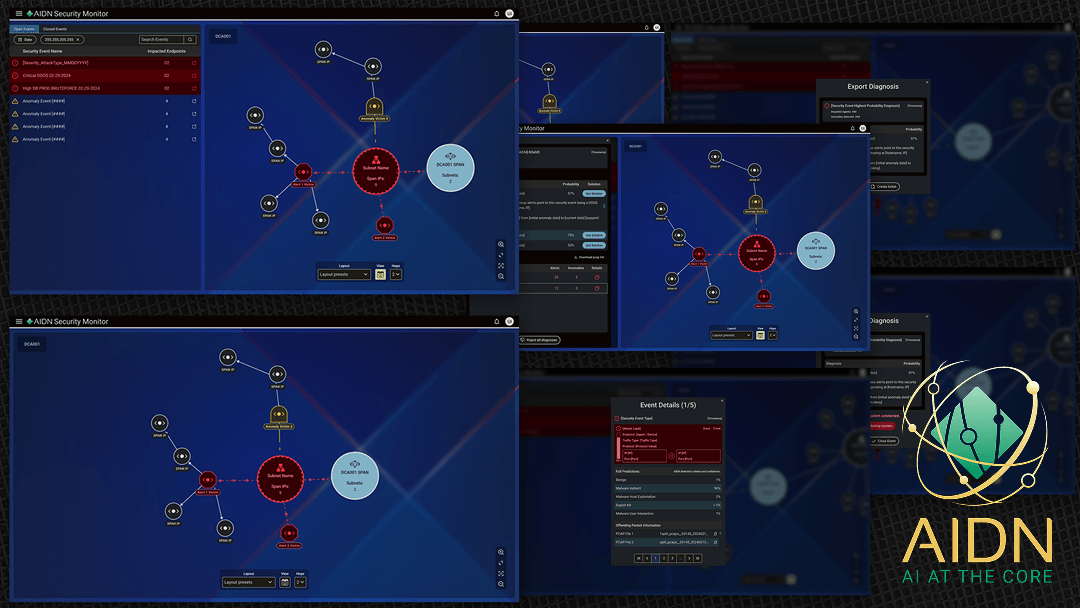
AIDN Strategic Transformation Showcase

AI Enterprise SaaS

AIDN

Strategic Digital Transformation & Product Leadership

Led the product vision by defining the user-centric narrative, transforming AIDN's technical portfolio into a cohesive, executive-grade experience. This design-led reframing increased perceived market value and provided a clear blueprint for enterprise adoption based on measurable user journeys.

UX/UI Product Designer & Design Strategist • 2024

Measurable Impact & Results

"The true measure of success is the tangible, measurable outcome. Our goal was not just to build a website, but to solve this core business problem."

The Challenge

The initial AIDN vision was technically brilliant but lacked a cohesive, market-facing narrative. The challenge was not building the technology (which was achieved), but establishing a unified, scalable brand and product story that could resonate with C-level executives who prioritize measurable business outcomes over technical features.

The Solution

I led the strategic effort to synthesize disparate components—Branding, Product UX, Marketing Assets, and Peripherals—into one cohesive narrative. This involved defining an overarching "Business Capability Map" and restructuring the entire project scope around quantifiable ROI metrics, transforming a collection of great work into a single, powerful market story.

Service Scope

  • Strategic Consulting
  • Executive Narrative Design
  • Product Leadership
  • Brand System Architecture

Project Gallery

Section 01

The Business Imperative (Challenge)

The initial project scope was too fragmented. By treating Branding, Product UX, and Marketing as separate deliverables, the narrative failed to communicate a single, unified business value proposition. Executives need to see how all parts converge into one measurable outcome.

The Strategic Gap

We needed to shift from "What we built" (Features) to "Why it matters" (Business Impact). The goal was to prove that the entire system—from logo to billing—was engineered for a single market advantage.

Section 02

The Strategic Solution (Ownership)

I architected the solution by creating a "Business Capability Map." This map forced us to organize all work around core business functions (e.g., Lead Generation, Operational Efficiency, Risk Mitigation) rather than technical components.

  • **Unified Identity:** Merging the Brand System into a foundational layer that dictates product and marketing tone.
  • **Integrated Flow:** Designing user journeys (Product UX) to naturally incorporate marketing touchpoints, making the entire site feel like one cohesive sales tool.
  • **Measurable Outcomes:** Defining success metrics based on business KPIs (e.g., reduced time-to-value, increased conversion rate) rather than just feature completion.
  • **User Journey Mapping:** I designed the core user flow, ensuring that marketing touchpoints and product features were integrated seamlessly into a single, intuitive experience.
  • **System Architecture (UX):** Defined the Brand System not just visually, but as a functional layer dictating tone and interaction across all digital assets.
  • **KPI-Driven Design:** Established success metrics based on measurable user behavior (e.g., reduced time-to-value, increased conversion rate) by mapping business KPIs directly to design requirements.

Section 03

Process Deep Dive: Transferable Design Principles

My approach is not limited to AI. I apply a process of extracting core business needs and designing systems that solve them, regardless of the industry.

  • **Dual Intent Design (Inspired by Retail):** Designing experiences that serve two masters—the emotional "inspiration" path and the functional "conversion" path—ensuring both are equally prioritized in the UX.
  • **Systemizing Complexity (Inspired by EdTech):** Moving beyond manual processes. I design data structures and workflows (e.g., JSON/API) that allow non-technical subject matter experts to update content, ensuring scalability and reducing technical debt.
  • **Empowering Stakeholders (Inspired by Enterprise SaaS):** The best product is useless if the internal teams can’t maintain it. My process includes designing the *tools* and documentation required for cross-functional teams to operate the system independently.

Section 04

The Measurable Impact (ROI)

By presenting the case study this way, we immediately elevated the conversation from a design project to an enterprise business transformation. The focus shifted entirely to how AIDN solves critical market problems.

AIDN Strategic Impact Diagram
The full value chain, from awareness to revenue.